
The AI Leaders Council’s 2026 Corporate AI Outlook Study offers more than adoption statistics. It reveals how organizations are allocating budget, managing risk, and redefining accountability as AI becomes part of everyday operations.
For CIOs and IT executives, these findings provide valuable insight into how AI is reshaping technology leadership expectations and investment priorities.
AI budgets are growing, but scrutiny is increasing
Most organizations expect AI budgets to increase in 2026, although growth is measured rather than aggressive. This reflects a shift in how AI is funded. Instead of experimental spend, AI is increasingly part of core technology planning.
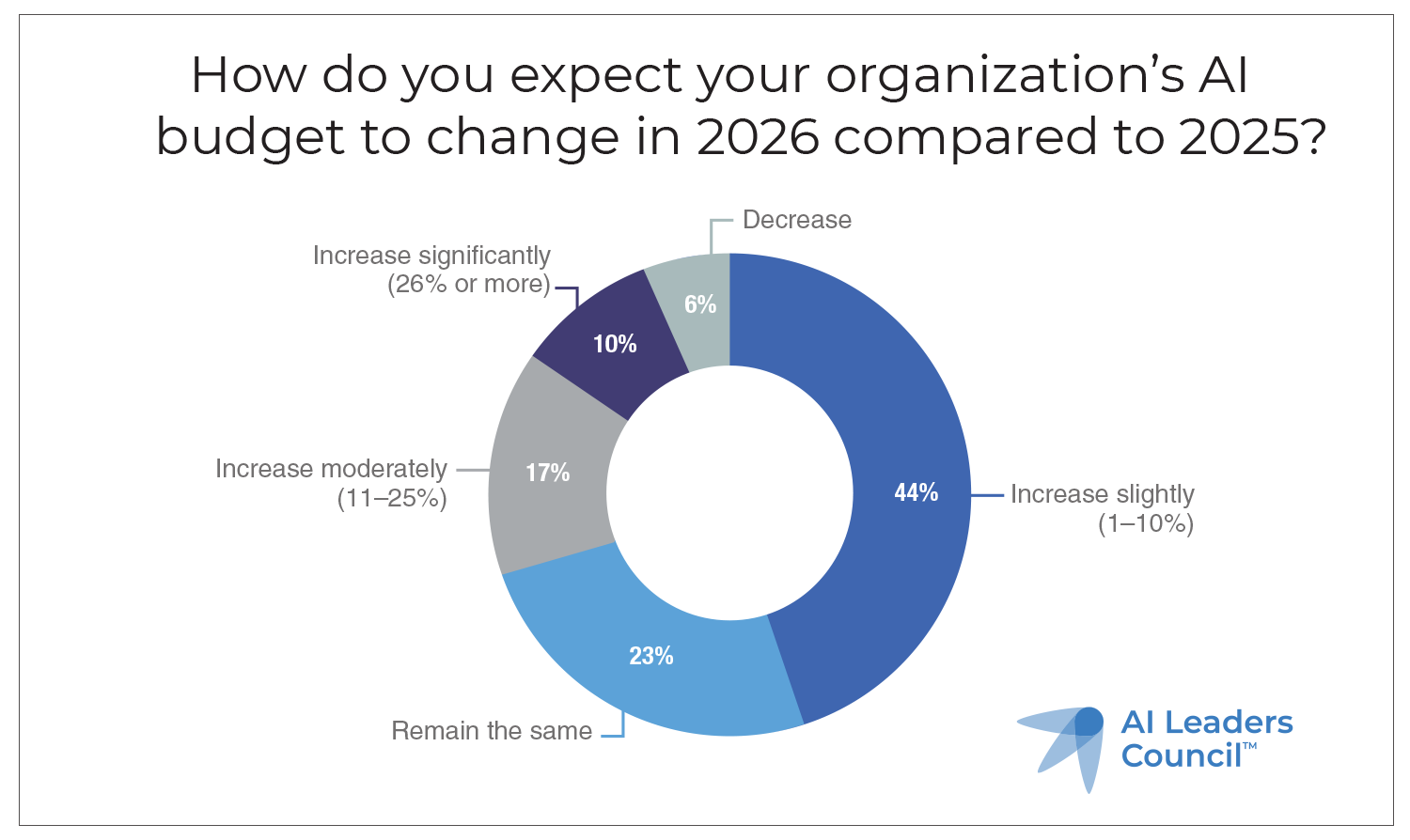
For IT leaders, this means greater accountability. AI investments are being evaluated alongside ERP platforms, cybersecurity programs, and infrastructure modernization initiatives. CIOs are expected to justify AI spend through operational efficiency, performance improvement, and risk reduction.
AI investment is moving toward foundational capabilities
The study shows that organizations are directing AI-related investment toward training, data platforms, cloud infrastructure, and adoption support. These priorities align closely with traditional IT responsibilities.

Rather than focusing solely on application-layer AI tools, organizations are strengthening the underlying foundations required to support scale. Data quality, platform reliability, and workforce readiness are emerging as critical enablers of AI success.
This places CIOs at the center of AI readiness conversations, even when business units lead individual use cases.
Risk management is becoming an IT leadership issue
Beyond security, the study highlights concerns around employee adoption, ROI uncertainty, regulatory compliance, and ethical considerations. Many of these risks intersect with IT governance models.

As AI adoption expands, CIOs are increasingly responsible for establishing guardrails that balance speed with control. This includes defining acceptable use policies, overseeing vendor integrations, monitoring system behavior, and supporting audit and compliance processes.
AI risk is no longer isolated within innovation teams. It is becoming part of enterprise risk management, where IT leadership plays a central role.
The CIO role is evolving alongside AI adoption
The combined investment and risk trends point to a broader shift in the CIO role. Technology leaders are not just enabling AI deployment. They are shaping how AI fits into enterprise architecture, security posture, and operating discipline.
CIOs who proactively engage with AI governance, platform strategy, and workforce enablement are better positioned to guide their organizations through this transition.
The 2026 Corporate AI Outlook Study provides deeper insight into how these dynamics are unfolding across organizations. Download the full report from the AI Leaders Council to see how enterprise leaders are planning, funding, and governing AI in 2026.


0 Comments