
Our partner community, the AI Leaders Council, recently released the 2026 Corporate AI Outlook Study, examining how organizations across North America are adopting and scaling artificial intelligence. While the study spans multiple executive roles, the findings are especially relevant for CIOs, CTOs, CISOs, and IT leaders.
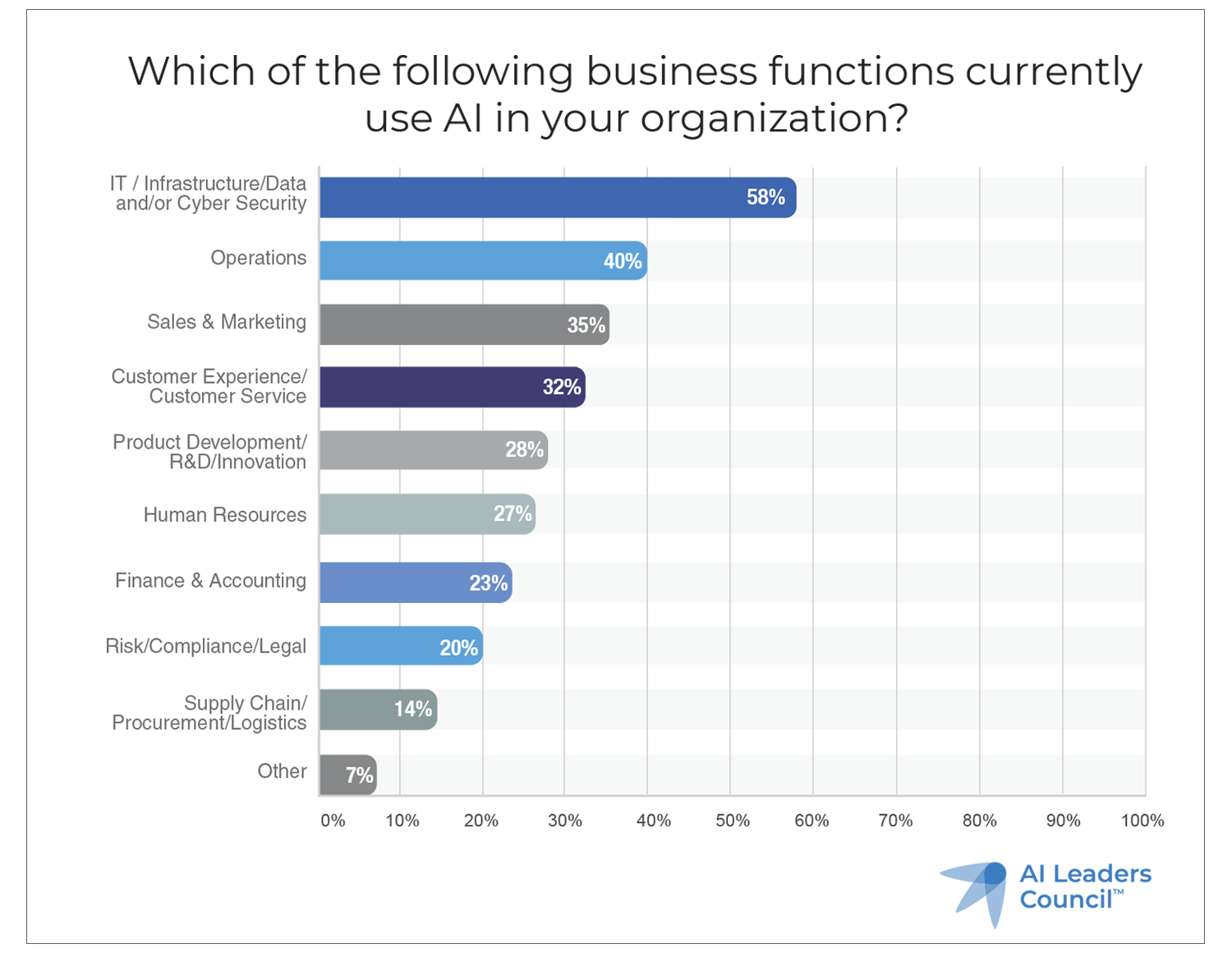
Across the dataset, AI adoption remains heavily anchored in IT, infrastructure, data, and security teams. This reality reflects a broader shift. AI is no longer viewed as a side project owned by innovation teams. It is increasingly becoming an operational responsibility that sits at the core of the technology organization.
IT continues to be the entry point for enterprise AI
Survey results show that IT, infrastructure, data, and security functions lead current AI usage. This is not surprising. These teams control the platforms, data pipelines, integration layers, and access policies that make AI deployment possible.
For many organizations, the first production AI workloads run through cloud environments managed by IT. Identity management, data governance, monitoring, and compliance all fall within traditional IT responsibility. As a result, CIOs are often the first executives asked to establish standards for AI deployment.
Platform decisions now shape AI outcomes
One of the clearest signals from the study is that most organizations rely on cloud platforms and external AI services rather than fully in-house development. This places additional weight on IT platform strategy.

Decisions around cloud providers, data architecture, integration tooling, and vendor governance directly affect AI performance, cost structure, and scalability. CIOs are no longer simply selecting infrastructure. They are defining the foundation on which AI capabilities are built.
This also introduces long-term dependency considerations. Vendor management, portability, and interoperability become strategic issues rather than procurement details.
Security and governance expectations are rising
The study highlights data privacy and security as the top risk associated with AI adoption. For IT leaders, this reinforces a growing responsibility. AI systems interact with sensitive data, internal systems, and customer-facing applications.

CIOs and CISOs are being asked to extend existing security frameworks to new types of workloads that involve model behavior, training data lineage, and third-party AI services. Traditional perimeter security is no longer sufficient on its own. Governance now includes oversight of how AI systems generate outputs and make recommendations.
IT leadership will define scalable AI adoption
As AI moves deeper into enterprise operations, IT leadership will increasingly shape whether adoption remains fragmented or becomes coordinated and sustainable. Organizations that treat AI as an extension of core IT architecture are better positioned to standardize deployment, enforce controls, and support cross-functional use.
The 2026 Corporate AI Outlook Study provides detailed data on how organizations are adopting AI and where responsibility is concentrating. Download the full report from the AI Leaders Council to benchmark how IT leaders are positioning their organizations for AI scale in 2026.


0 Comments